|
1:Actions
|
|
1:Define
|
|
Define
|
|
2:Recall Definition
|
|
|
|
3:Delete Variable
|
|
DelVar
|
|
4:Clear A-Z...
|
|
ClearAZ
|
|
5:Clear History
|
|
|
|
6:Insert Comment
|
|
ⓒ
|
|
7:Library
|
1:Refresh Libraries
|
|
|
2:Insert "\" character
|
\
|
|
3:Create Library Shortcut
|
libShortcut()
|
|
4:Define LibPriv
|
Define LibPriv
|
|
5:Define LibPub (show in Catalog)
|
Define LibPub
|
|
8:Lock
|
1:Lock Variable
|
Lock
|
|
2:Unlock Variable
|
Unlock
|
|
3:Get Lock Info
|
getLockInfo()
|
|
|
2:Number
|
|
1:Convert to Decimal
|
|
▶Decimal
|
|
2:Approximate to Fraction
|
|
▶approxFraction()
|
|
3:Factor
|
|
factor()
|
|
4:Least Common Multiful
|
|
lcm()
|
|
5:Greatest Common Divisor
|
|
gcd()
|
|
6:Remainder
|
|
remain()
|
|
7:Fraction Tools
|
1:Proper Fraction
|
propFrac()
|
|
2:Get Numerator
|
getNum()
|
|
3:Get Denominator
|
getDenom()
|
|
4:Common Denominator
|
comDenom()
|
|
8:Number Tools
|
1:Round
|
round() |
|
2:Integer Part
|
iPart() |
|
3:Fractional Part
|
fPart() |
|
4:Sign
|
sign()
|
|
5:Mod
|
mod() |
|
6:Floor
|
floor()
|
|
7:Ceiling
|
ceiling() |
|
9:Complex Number Tools
|
1:Complex Conjugate
|
conj() |
|
2:Real Part
|
real() |
|
3:Imaginary Part
|
imag() |
|
4:Polar Angel
|
angle() |
|
5:Magnitude
|
abs() |
|
6:Convert to Polar
|
▶Polar |
|
7:Convert to Rectangular
|
▶Rect
|
|
|
3:Algebra
|
|
1:Solve
|
|
solve()
|
|
2:Factor
|
|
factor()
|
|
3:Expand
|
|
expand()
|
|
4:Zeros
|
|
zeros()
|
|
5:Complete the Square
|
|
completeSquare()
|
|
6:Numerical Solve
|
|
nSplve()
|
|
7:Solve System of Equations
|
1:Solve System of Equations...
|
solve()
|
|
2:Solve System of Linear Equations...
|
linSolve()
|
|
8:Polyominal Tools
|
1:Find Roots of Polynominal...
|
polyRoots()
|
|
2:Real Roots of Polynominal
|
polyRoots()
|
|
3:Complex Roots of Polynominals
|
cPolyRoots()
|
|
4:Remainder of Polynominal
|
polyRemainder()
|
|
5:Quotient of Polynominal
|
polyQuotient()
|
|
6:Greatest Common Divisor
|
polyGcd()
|
|
7:Coefficients of Polynominal
|
polyCoeffs()
|
|
8:Degree of Polynominal
|
polyDegree()
|
|
9:Fraction Tools
|
1:Proper Fraction
|
propFrac()
|
|
2:Get Numerator
|
getNum()
|
|
3:Get Denominator
|
getDenom()
|
|
4:Common Denominator
|
comDenom()
|
|
A:Convert Expression
|
1:Convert to ln
|
▶ln
|
|
2:Convert to logbase
|
▶logbase()
|
|
3:Convert to exp
|
▶exp
|
|
4:Convert to sin
|
▶sin
|
|
5:Convert to cos
|
▶cos
|
|
B:Trigonometry
|
1:Expand
|
tExpand()
|
|
2:Collect
|
tCollect()
|
|
C:Complex
|
1:Solve
|
cSolve()
|
|
2:Factor
|
cFactor()
|
|
3:Zeros
|
cZeros()
|
|
D:Extract
|
1:Left
|
left()
|
|
2:Right
|
right()
|
|
|
4:Calculus
|
|
1:Derivative
|
|
d()/d
|
|
2:Derivative at a point...
|
|
d()/d|x=O
|
|
3:Integral
|
|
∫()
|
|
4:Limit
|
|
lim()
|
|
5:Sum
|
|
∑()
|
|
6:Product
|
|
∏()
|
|
7:Function Minimum
|
|
fMin()
|
|
8:Function Maximum
|
|
fMax()
|
|
9:Tangent Line
|
|
tangentLine()
|
|
A:Normal Line
|
|
normalLine()
|
|
B:Arc Length
|
|
arcLen()
|
|
C:Series
|
1:Taylor Polynominal
|
taylor()
|
|
2:Generalized Series
|
taylor()
|
|
3:Dominant Term
|
dominantTerm()
|
|
D:Differential Equation Solver
|
|
deSolve()
|
|
E:Implicit Differentiation
|
|
impDif()
|
|
F:Numerical Calculations
|
1:Numerical Derivative at a point
|
nDerivative()
|
|
2:Central Difference Quotient with Step
|
centralDiff()
|
|
3:Numerical Integral
|
nInt()
|
|
4:Numerical Function Minimum
|
nfMin()
|
|
5:Numerical Function Maximum
|
nfMax()
|
|
|
5:Probability
|
|
1:Factorial(!)
|
|
!
|
|
2:Permutations
|
|
nPr()
|
|
3:Combinations
|
|
nCr()
|
|
4:Random
|
1:Number
|
rand()
|
|
2:Integer
|
randInt()
|
|
3:Binominal
|
randBin()
|
|
4:Normal
|
randNorm()
|
|
5:Sample
|
randSamp()
|
|
6:Seed
|
RandSeed
|
|
5:Distributions
|
1:Normal Pdf...
|
normPdf()
|
|
2:Normal Cdf...
|
normCdf()
|
|
3:Inverse Normal...
|
invNorm()
|
|
4:t Pdf...
|
tPdf()
|
|
5:t Cdf...
|
tCdf()
|
|
6:Inverse t...
|
invt()
|
|
7:χ² Pdf...
|
χ²Pdf()
|
|
8:χ² Cdf...
|
χ²Cdf()
|
|
9:Inverse χ²...
|
invχ²()
|
|
A:Binominal Pdf...
|
binomPdf()
|
|
B:Binominal Cdf...
|
binomCdf()
|
|
C:Inverse Binomial...
|
invBinom()
|
|
D:Inverse Binomial N...
|
invBinomN()
|
|
E:F Pdf...
|
FPdf()
|
|
F:F Cdf...
|
FCdf()
|
|
G:Inverse F...
|
invF()
|
|
H:Geometric Pdf...
|
geomPdf()
|
|
I:Geometric Cdf...
|
geomCdf()
|
| J:Poisson Pdf... |
poissPdf() |
| K:Poisson Cdf... |
poissCdf() |
|
|
6:Statistics
|
|
1:Stat Calculations
|
1:One-Variable Statistics...
|
OneVar
|
|
2:Two-Variable Statistics...
|
TwoVar
|
|
3:Linear Regression (mx+b)...
|
LinRegMx
|
|
4:Linear Regression (a+bx)...
|
LinRegBx
|
|
5:Median-Median Line...
|
MedMed
|
|
6:Quadratic Regression...
|
QuadReg
|
|
7:Cubic Regression...
|
CubicReg
|
|
8:Quartic Regression...
|
QuartReg
|
|
9:Power Regression...
|
PowerReg
|
|
A:Exponential Regression...
|
ExpReg
|
|
B: Logarithmic Regression...
|
LnReg
|
|
C:Sunusoidal Regression...
|
SinReg
|
|
D:Logistic Regression...(d=0)
|
Logistic
|
|
E:Logistic Regression...(d≠0)
|
LogisticD
|
|
F:Multiple Linear Regression...
|
MultReg
|
|
G:Correlation Matrix
|
corrMat()
|
|
2:Stat Results
|
|
Stat.results
|
|
3:List Math
|
1:Munumum
|
min()
|
|
2:Maximum
|
max()
|
|
3:Mean
|
mean()
|
|
4:Median
|
median()
|
|
5:Sum of Elements
|
sum()
|
|
6:Product of Elements
|
product()
|
|
7:Sample Standard Deviation
|
stDevSamp()
|
|
8:Sample Variance
|
varSamp()
|
|
9:Population Standard Deviation
|
stDevPop()
|
|
A:Population Variance
|
varPop()
|
|
4:List Operations
|
1:Sort Ascending
|
SortA
|
|
2:Sort Descending
|
SortD
|
|
3:Cumulative Sum List
|
cumulativeSum()
|
|
4:Fill
|
Fill
|
|
5:Sequence
|
Seq()
|
|
6:Difference List
|
ΔList()
|
|
7:Augment
|
augment()
|
|
8:Convert List to Matrix
|
list▶mat()
|
|
9:Convert Matrix to List
|
mat▶list()
|
|
A:Left
|
left()
|
|
B:Mid
|
mid()
|
|
C:Right
|
right()
|
|
5:Distribution
|
|
5.Probability와 동일
|
|
6:Confidence Intervals
|
1:z Interval... |
zInterval
|
|
2:t Interval...
|
tInterval
|
|
3:2-Sample z Interval...
|
zInterval_2Samp
|
|
4:2-Sample t Interval...
|
tInterval_2Samp
|
|
5:1-Prop z Interval...
|
zInterval_1Prop
|
|
6:2-Prop z Interval...
|
zInterval_2Prop
|
|
7:Linear Reg t Intervals...
|
LinRegtIntervals
|
|
8:Multiple Reg Intervals...
|
MultRegIntervals
|
|
7:Stat Tests
|
1:z Test...
|
zTest
|
|
2:t Test...
|
tTest
|
|
3:2-Sample z Test...
|
zTest_2Samp
|
|
4:2-Sample t Test...
|
tTest_2Samp
|
|
5:1-Prop z Test...
|
zTest_1Prop
|
|
6:2-Prop z Test...
|
zTest_2Prop
|
|
7:χ² GOF...
|
χ²GOF
|
|
8:χ² 2-way Test...
|
χ²2Way
|
|
9:2-Sample F Test...
|
FTest_2Samp
|
|
A:Linear Reg t Test...
|
LinRegtTest
|
|
B:Multiple Reg t Test...
|
MultRegtTest
|
|
C:ANOVA...
|
ANOVA
|
|
D:ANOVA 2-Way...
|
ANOVA2way
|
|
|
7:Matrix & Vector
|
|
1:Create
|
1:Matrix...
|
|
|
2:Zero Matrix
|
newMat()
|
|
3:Identify
|
identity()
|
|
4:Diagonal
|
diag()
|
|
5:Random Matrix
|
randMat()
|
|
6:Fill
|
Fill
|
|
7:Submatrix
|
subMat()
|
|
8:Augment
|
augment()
|
|
9:Column Augment
|
colAugment()
|
|
A:Construct Matrix
|
constructMat()
|
|
2:Transpose
|
|
T
|
|
3:Determinant
|
|
det() |
|
4:Row-Echelon Form
|
|
ref()
|
|
5:Reduced Row-Echelon Form
|
|
rref()
|
|
6:Simultaneous
|
|
simult()
|
|
7:Norms
|
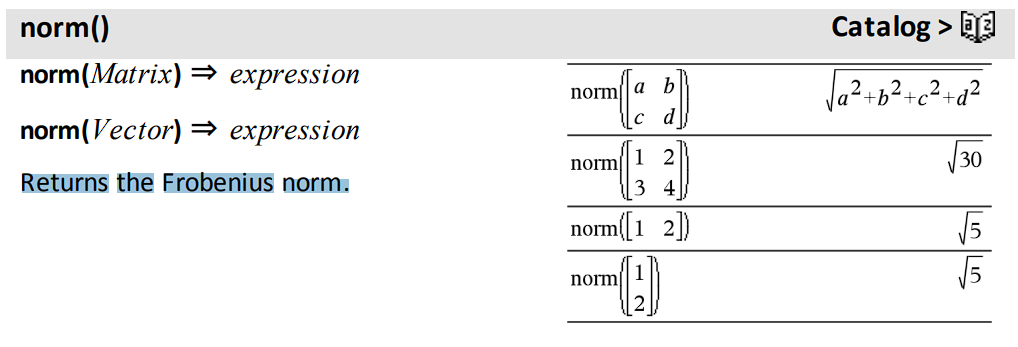
1:Norm |
norm()
|
|
2:Row
|
rowNorm()
|
|
3:Column
|
colNorm()
|
|
8:Dimensions
|
1:Matrix
|
dim()
|
|
2:Row
|
rowDim()
|
|
3:Column
|
colDim()
|
|
9:Row Operations
|
1:Swap Rows |
rowSwap()
|
|
2:Row Add
|
rowAdd()
|
|
3:Multiply Row
|
mRow()
|
|
4:Multiply Row & Add
|
mRowAdd()
|
|
A:Element Operations
|
1:Dot Add
|
.+
|
|
2:Dot Subtract
|
.-
|
|
3:Dot Multiply
|
.×
|
|
4:Dot Divide
|
.÷
|
|
5:Dot Power
|
.^
|
|
B:Advanced
|
1:Trace
|
trace()
|
|
2:LU Decomposition
|
LU
|
|
3:QR Decomposition
|
QR
|
|
4:Eigenvalues
|
eigVl()
|
|
5:Eigenvectors
|
eigVc()
|
|
6:Characteristic Polynominal
|
charPoly()
|
|
C:Vector
|
1:Unit Vector
|
unitV()
|
|
2:Cross Product
|
crossP()
|
|
3:Dot Product
|
dotP()
|
|
4:Convert to Polar
|
▶Polar
|
|
5:Convert to Rectangular
|
▶Rect
|
|
6:Convert to Cylindrical
|
▶Cylind
|
|
7:Convert to Spherical
|
▶Sphere
|
|
|
8:Finance
|
|
1:Finance Solver...
|
|
|
|
2:TVM Functions
|
1:Number of Periods
|
tvmN()
|
|
2:Interest Rate per Year
|
tvmI()
|
|
3:Present Value
|
tvmPV()
|
|
4:Payment Amount
|
tvmPMT()
|
|
5:Future Value
|
tvmFV()
|
|
3:Amortization
|
1:Amortization Table
|
amortTbl()
|
|
2:Balance
|
bal()
|
|
3:Interest Paid
|
ΣInt()
|
|
4:Principal Paid
|
ΣPrn()
|
|
4:Cash Flows
|
1:Net Present Value
|
npv()
|
|
2:Internal Rate of Return
|
irr()
|
|
3:Modified Internal Rate of Return
|
mirr() |
|
5:Interest Conversion
|
1:Nominal Interest Rate
|
nom()
|
|
2:Effective Interest Rate
|
eff()
|
|
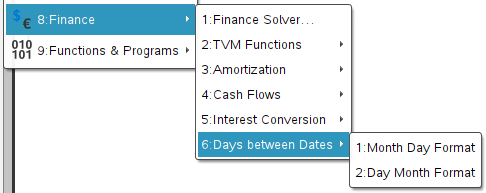
6:Days between Dates
|
Day Month Format
|
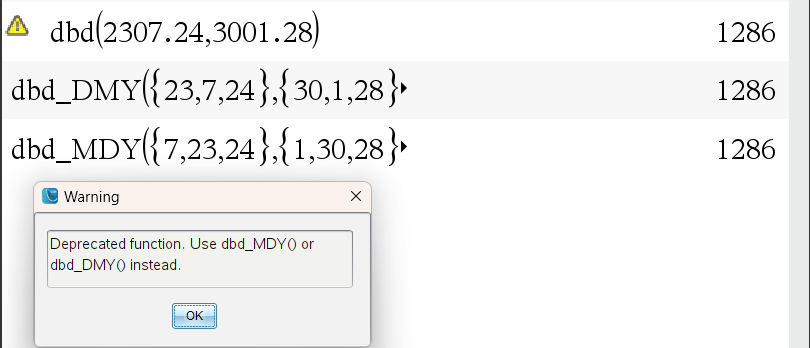
dbd_DMY()
|
| Month Day Format |
dbd_MDY() |
|
|
9:Functions & Programs
|
|
1:Program Editor
|
1:New...
|
|
|
2:Open...
|
|
|
3:Import...
|
|
|
4:View...
|
|
|
2:Func...EndFunc
|
|
|
|
3:Prgm...EndPrgm
|
|
|
|
4:Local
|
|
|
|
5:Control
|
1:If
|
|
|
2:If...Then...EndIf
|
|
|
3:If...Then...Else...EndIf
|
|
|
4:ElseIf...Then
|
|
|
5:For...EndFor
|
|
|
6.While...EndWhile
|
|
|
7.Loop...EndLoop
|
|
|
8.Try...Else...EndTry
|
|
|
9.ClrErr
|
|
|
A:PassErr
|
|
|
B:errCode
|
|
|
C:warnCodes
|
|
| D:wait |
|
|
6:Transfer
|
1:Return
|
|
|
2:Cycle
|
|
|
3:Exit
|
|
|
4:Lbl
|
|
|
5:GoTo Lbl
|
|
|
6:Stop
|
|
|
7:I/O
|
1:Disp
|
|
|
2:Dispat
|
|
|
3:Request
|
|
| 4:RequestStr |
|
| 5:Text |
|
| 6:getKey |
|
| 7:Get |
|
| 8:Getstr |
|
| 9:Send |
|
|
A:RefreshProbeVars
|
|
|
8:Mode
|
1:Display Digits
|
Float, Float1~12, Fix0~12
|
|
2:Angle
|
Radian, Degree, Gradian
|
|
3:Exponential Format
|
Normal, Scientific, Engineering
|
|
4:Real or Complex
|
Real, Rectangular, Polar
|
|
5:Auto or Approx
|
Auto, Approximate, Exact
|
|
6:Vector Format
|
Rectangular, Cylinderical, Spherical
|
|
7:Base
|
Decimal, Hex, Binary
|
|
8:Unit System
|
SI, Eng/US
|
|
9:Get Mode
|
|
| A:Get Language Info |
|
|
B:Get PlatFormInfo
|
|
|
9:Add New Line
|
|
|
|

세상의모든계산기 님의 최근 댓글
링크가 깨졌다고 하시니 404 에러가 나는 아래 링크를 말씀하시는 것 같은데 https://digilander.libero.it/fpirozzi/fourier.zip 이것은 TI-89 / TI-92 용 파일이며 [TI-92][TI-89] Fourier Transform Library https://allcalc.org/52455 링크의 Attached files + 안에 있습니다. 2026 09.11 본문에 사용된 nspire 용 파일은 본문 하단에 Attached files + 안에 있습니다. 클릭하면 표시됩니다. 2026 09.11 이 사이트에 올라와 있는 첨부 파일은 본문 하단에 있는 [Attached files +] 버튼을 눌러야 리스트가 보입니다. 2026 09.07 이렇게 질문하시면 무슨 파일인지 알 수가 없습니다. 해당 글에 댓글을 쓰시는게 최선이며, 권한 문제로 그것이 불가능하면 해당 글의 주소를 붙여넣으시거나, 제목 전체를 복사해 넣으셔야 구분이 됩니다. 2026 09.07 - claude AI는 l-c*r^2 을 1-c*r^2 으로 잘못 읽고 표시하고 있습니다. - TI-nspire CAS 계산기에 l-c*r^2 ≥0 을 조건에 추가해 계산해 보아도 결과는 바뀌지 않습니다. 2026 07.20