|
1:Actions
|
|
1:Define
|
|
Define
|
|
2:Recall Definition
|
|
|
|
3:Delete Variable
|
|
DelVar
|
|
4:Clear A-Z...
|
|
ClearAZ
|
|
5:Clear History
|
|
|
|
6:Insert Comment
|
|
ⓒ
|
|
7:Library
|
1:Refresh Libraries
|
|
|
2:Insert "\" character
|
\
|
|
3:Create Library Shortcut
|
libShortcut()
|
|
4:Define LibPriv
|
Define LibPriv
|
|
5:Define LibPub (show in Catalog)
|
Define LibPub
|
|
8:Lock
|
1:Lock Variable
|
Lock
|
|
2:Unlock Variable
|
Unlock
|
|
3:Get Lock Info
|
getLockInfo()
|
|
|
2:Number
|
|
1:Convert to Decimal
|
|
▶Decimal
|
|
2:Approximate to Fraction
|
|
▶approxFraction()
|
|
3:Factor
|
|
factor()
|
|
4:Least Common Multiful
|
|
lcm()
|
|
5:Greatest Common Divisor
|
|
gcd()
|
|
6:Remainder
|
|
remain()
|
|
7:Fraction Tools
|
1:Proper Fraction
|
propFrac()
|
|
2:Get Numerator
|
getNum()
|
|
3:Get Denominator
|
getDenom()
|
|
4:Common Denominator
|
comDenom()
|
|
8:Number Tools
|
1:Round
|
round() |
|
2:Integer Part
|
iPart() |
|
3:Fractional Part
|
fPart() |
|
4:Sign
|
sign()
|
|
5:Mod
|
mod() |
|
6:Floor
|
floor()
|
|
7:Ceiling
|
ceiling() |
|
9:Complex Number Tools
|
1:Complex Conjugate
|
conj() |
|
2:Real Part
|
real() |
|
3:Imaginary Part
|
imag() |
|
4:Polar Angel
|
angle() |
|
5:Magnitude
|
abs() |
|
6:Convert to Polar
|
▶Polar |
|
7:Convert to Rectangular
|
▶Rect
|
|
|
3:Algebra
|
|
1:Solve
|
|
solve()
|
|
2:Factor
|
|
factor()
|
|
3:Expand
|
|
expand()
|
|
4:Zeros
|
|
zeros()
|
|
5:Complete the Square
|
|
completeSquare()
|
|
6:Numerical Solve
|
|
nSplve()
|
|
7:Solve System of Equations
|
1:Solve System of Equations...
|
solve()
|
|
2:Solve System of Linear Equations...
|
linSolve()
|
|
8:Polyominal Tools
|
1:Find Roots of Polynominal...
|
polyRoots()
|
|
2:Real Roots of Polynominal
|
polyRoots()
|
|
3:Complex Roots of Polynominals
|
cPolyRoots()
|
|
4:Remainder of Polynominal
|
polyRemainder()
|
|
5:Quotient of Polynominal
|
polyQuotient()
|
|
6:Greatest Common Divisor
|
polyGcd()
|
|
7:Coefficients of Polynominal
|
polyCoeffs()
|
|
8:Degree of Polynominal
|
polyDegree()
|
|
9:Fraction Tools
|
1:Proper Fraction
|
propFrac()
|
|
2:Get Numerator
|
getNum()
|
|
3:Get Denominator
|
getDenom()
|
|
4:Common Denominator
|
comDenom()
|
|
A:Convert Expression
|
1:Convert to ln
|
▶ln
|
|
2:Convert to logbase
|
▶logbase()
|
|
3:Convert to exp
|
▶exp
|
|
4:Convert to sin
|
▶sin
|
|
5:Convert to cos
|
▶cos
|
|
B:Trigonometry
|
1:Expand
|
tExpand()
|
|
2:Collect
|
tCollect()
|
|
C:Complex
|
1:Solve
|
cSolve()
|
|
2:Factor
|
cFactor()
|
|
3:Zeros
|
cZeros()
|
|
D:Extract
|
1:Left
|
left()
|
|
2:Right
|
right()
|
|
|
4:Calculus
|
|
1:Derivative
|
|
d()/d
|
|
2:Derivative at a point...
|
|
d()/d|x=O
|
|
3:Integral
|
|
∫()
|
|
4:Limit
|
|
lim()
|
|
5:Sum
|
|
∑()
|
|
6:Product
|
|
∏()
|
|
7:Function Minimum
|
|
fMin()
|
|
8:Function Maximum
|
|
fMax()
|
|
9:Tangent Line
|
|
tangentLine()
|
|
A:Normal Line
|
|
normalLine()
|
|
B:Arc Length
|
|
arcLen()
|
|
C:Series
|
1:Taylor Polynominal
|
taylor()
|
|
2:Generalized Series
|
taylor()
|
|
3:Dominant Term
|
dominantTerm()
|
|
D:Differential Equation Solver
|
|
deSolve()
|
|
E:Implicit Differentiation
|
|
impDif()
|
|
F:Numerical Calculations
|
1:Numerical Derivative at a point
|
nDerivative()
|
|
2:Central Difference Quotient with Step
|
centralDiff()
|
|
3:Numerical Integral
|
nInt()
|
|
4:Numerical Function Minimum
|
nfMin()
|
|
5:Numerical Function Maximum
|
nfMax()
|
|
|
5:Probability
|
|
1:Factorial(!)
|
|
!
|
|
2:Permutations
|
|
nPr()
|
|
3:Combinations
|
|
nCr()
|
|
4:Random
|
1:Number
|
rand()
|
|
2:Integer
|
randInt()
|
|
3:Binominal
|
randBin()
|
|
4:Normal
|
randNorm()
|
|
5:Sample
|
randSamp()
|
|
6:Seed
|
RandSeed
|
|
5:Distributions
|
1:Normal Pdf...
|
normPdf()
|
|
2:Normal Cdf...
|
normCdf()
|
|
3:Inverse Normal...
|
invNorm()
|
|
4:t Pdf...
|
tPdf()
|
|
5:t Cdf...
|
tCdf()
|
|
6:Inverse t...
|
invt()
|
|
7:χ² Pdf...
|
χ²Pdf()
|
|
8:χ² Cdf...
|
χ²Cdf()
|
|
9:Inverse χ²...
|
invχ²()
|
|
A:Binominal Pdf...
|
binomPdf()
|
|
B:Binominal Cdf...
|
binomCdf()
|
|
C:Inverse Binomial...
|
invBinom()
|
|
D:Inverse Binomial N...
|
invBinomN()
|
|
E:F Pdf...
|
FPdf()
|
|
F:F Cdf...
|
FCdf()
|
|
G:Inverse F...
|
invF()
|
|
H:Geometric Pdf...
|
geomPdf()
|
|
I:Geometric Cdf...
|
geomCdf()
|
| J:Poisson Pdf... |
poissPdf() |
| K:Poisson Cdf... |
poissCdf() |
|
|
6:Statistics
|
|
1:Stat Calculations
|
1:One-Variable Statistics...
|
OneVar
|
|
2:Two-Variable Statistics...
|
TwoVar
|
|
3:Linear Regression (mx+b)...
|
LinRegMx
|
|
4:Linear Regression (a+bx)...
|
LinRegBx
|
|
5:Median-Median Line...
|
MedMed
|
|
6:Quadratic Regression...
|
QuadReg
|
|
7:Cubic Regression...
|
CubicReg
|
|
8:Quartic Regression...
|
QuartReg
|
|
9:Power Regression...
|
PowerReg
|
|
A:Exponential Regression...
|
ExpReg
|
|
B: Logarithmic Regression...
|
LnReg
|
|
C:Sunusoidal Regression...
|
SinReg
|
|
D:Logistic Regression...(d=0)
|
Logistic
|
|
E:Logistic Regression...(d≠0)
|
LogisticD
|
|
F:Multiple Linear Regression...
|
MultReg
|
|
G:Correlation Matrix
|
corrMat()
|
|
2:Stat Results
|
|
Stat.results
|
|
3:List Math
|
1:Munumum
|
min()
|
|
2:Maximum
|
max()
|
|
3:Mean
|
mean()
|
|
4:Median
|
median()
|
|
5:Sum of Elements
|
sum()
|
|
6:Product of Elements
|
product()
|
|
7:Sample Standard Deviation
|
stDevSamp()
|
|
8:Sample Variance
|
varSamp()
|
|
9:Population Standard Deviation
|
stDevPop()
|
|
A:Population Variance
|
varPop()
|
|
4:List Operations
|
1:Sort Ascending
|
SortA
|
|
2:Sort Descending
|
SortD
|
|
3:Cumulative Sum List
|
cumulativeSum()
|
|
4:Fill
|
Fill
|
|
5:Sequence
|
Seq()
|
|
6:Difference List
|
ΔList()
|
|
7:Augment
|
augment()
|
|
8:Convert List to Matrix
|
list▶mat()
|
|
9:Convert Matrix to List
|
mat▶list()
|
|
A:Left
|
left()
|
|
B:Mid
|
mid()
|
|
C:Right
|
right()
|
|
5:Distribution
|
|
5.Probability와 동일
|
|
6:Confidence Intervals
|
1:z Interval... |
zInterval
|
|
2:t Interval...
|
tInterval
|
|
3:2-Sample z Interval...
|
zInterval_2Samp
|
|
4:2-Sample t Interval...
|
tInterval_2Samp
|
|
5:1-Prop z Interval...
|
zInterval_1Prop
|
|
6:2-Prop z Interval...
|
zInterval_2Prop
|
|
7:Linear Reg t Intervals...
|
LinRegtIntervals
|
|
8:Multiple Reg Intervals...
|
MultRegIntervals
|
|
7:Stat Tests
|
1:z Test...
|
zTest
|
|
2:t Test...
|
tTest
|
|
3:2-Sample z Test...
|
zTest_2Samp
|
|
4:2-Sample t Test...
|
tTest_2Samp
|
|
5:1-Prop z Test...
|
zTest_1Prop
|
|
6:2-Prop z Test...
|
zTest_2Prop
|
|
7:χ² GOF...
|
χ²GOF
|
|
8:χ² 2-way Test...
|
χ²2Way
|
|
9:2-Sample F Test...
|
FTest_2Samp
|
|
A:Linear Reg t Test...
|
LinRegtTest
|
|
B:Multiple Reg t Test...
|
MultRegtTest
|
|
C:ANOVA...
|
ANOVA
|
|
D:ANOVA 2-Way...
|
ANOVA2way
|
|
|
7:Matrix & Vector
|
|
1:Create
|
1:Matrix...
|
|
|
2:Zero Matrix
|
newMat()
|
|
3:Identify
|
identity()
|
|
4:Diagonal
|
diag()
|
|
5:Random Matrix
|
randMat()
|
|
6:Fill
|
Fill
|
|
7:Submatrix
|
subMat()
|
|
8:Augment
|
augment()
|
|
9:Column Augment
|
colAugment()
|
|
A:Construct Matrix
|
constructMat()
|
|
2:Transpose
|
|
T
|
|
3:Determinant
|
|
det() |
|
4:Row-Echelon Form
|
|
ref()
|
|
5:Reduced Row-Echelon Form
|
|
rref()
|
|
6:Simultaneous
|
|
simult()
|
|
7:Norms
|
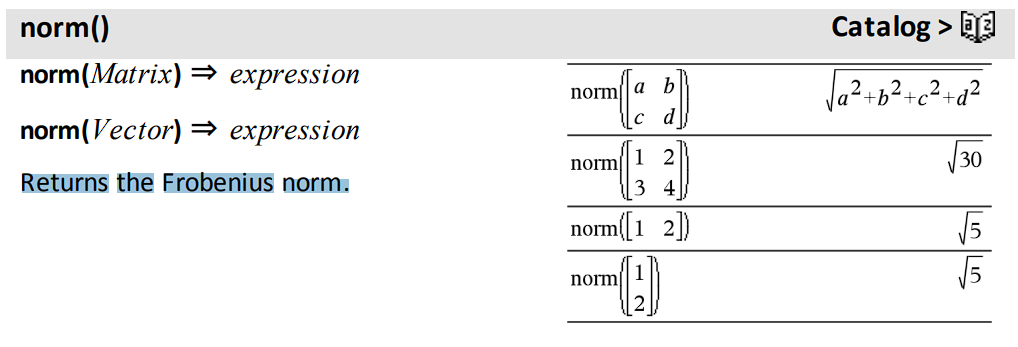
1:Norm |
norm()
|
|
2:Row
|
rowNorm()
|
|
3:Column
|
colNorm()
|
|
8:Dimensions
|
1:Matrix
|
dim()
|
|
2:Row
|
rowDim()
|
|
3:Column
|
colDim()
|
|
9:Row Operations
|
1:Swap Rows |
rowSwap()
|
|
2:Row Add
|
rowAdd()
|
|
3:Multiply Row
|
mRow()
|
|
4:Multiply Row & Add
|
mRowAdd()
|
|
A:Element Operations
|
1:Dot Add
|
.+
|
|
2:Dot Subtract
|
.-
|
|
3:Dot Multiply
|
.×
|
|
4:Dot Divide
|
.÷
|
|
5:Dot Power
|
.^
|
|
B:Advanced
|
1:Trace
|
trace()
|
|
2:LU Decomposition
|
LU
|
|
3:QR Decomposition
|
QR
|
|
4:Eigenvalues
|
eigVl()
|
|
5:Eigenvectors
|
eigVc()
|
|
6:Characteristic Polynominal
|
charPoly()
|
|
C:Vector
|
1:Unit Vector
|
unitV()
|
|
2:Cross Product
|
crossP()
|
|
3:Dot Product
|
dotP()
|
|
4:Convert to Polar
|
▶Polar
|
|
5:Convert to Rectangular
|
▶Rect
|
|
6:Convert to Cylindrical
|
▶Cylind
|
|
7:Convert to Spherical
|
▶Sphere
|
|
|
8:Finance
|
|
1:Finance Solver...
|
|
|
|
2:TVM Functions
|
1:Number of Periods
|
tvmN()
|
|
2:Interest Rate per Year
|
tvmI()
|
|
3:Present Value
|
tvmPV()
|
|
4:Payment Amount
|
tvmPMT()
|
|
5:Future Value
|
tvmFV()
|
|
3:Amortization
|
1:Amortization Table
|
amortTbl()
|
|
2:Balance
|
bal()
|
|
3:Interest Paid
|
ΣInt()
|
|
4:Principal Paid
|
ΣPrn()
|
|
4:Cash Flows
|
1:Net Present Value
|
npv()
|
|
2:Internal Rate of Return
|
irr()
|
|
3:Modified Internal Rate of Return
|
mirr() |
|
5:Interest Conversion
|
1:Nominal Interest Rate
|
nom()
|
|
2:Effective Interest Rate
|
eff()
|
|
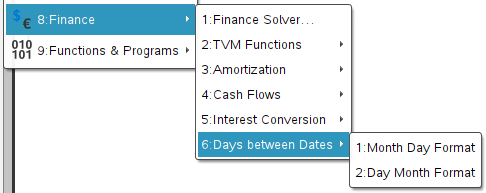
6:Days between Dates
|
Day Month Format
|
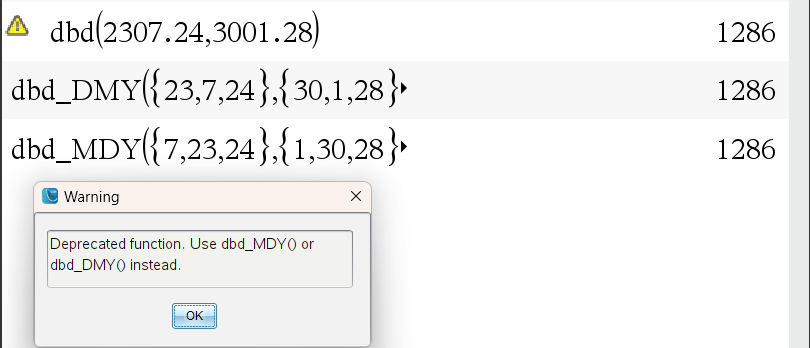
dbd_DMY()
|
| Month Day Format |
dbd_MDY() |
|
|
9:Functions & Programs
|
|
1:Program Editor
|
1:New...
|
|
|
2:Open...
|
|
|
3:Import...
|
|
|
4:View...
|
|
|
2:Func...EndFunc
|
|
|
|
3:Prgm...EndPrgm
|
|
|
|
4:Local
|
|
|
|
5:Control
|
1:If
|
|
|
2:If...Then...EndIf
|
|
|
3:If...Then...Else...EndIf
|
|
|
4:ElseIf...Then
|
|
|
5:For...EndFor
|
|
|
6.While...EndWhile
|
|
|
7.Loop...EndLoop
|
|
|
8.Try...Else...EndTry
|
|
|
9.ClrErr
|
|
|
A:PassErr
|
|
|
B:errCode
|
|
|
C:warnCodes
|
|
| D:wait |
|
|
6:Transfer
|
1:Return
|
|
|
2:Cycle
|
|
|
3:Exit
|
|
|
4:Lbl
|
|
|
5:GoTo Lbl
|
|
|
6:Stop
|
|
|
7:I/O
|
1:Disp
|
|
|
2:Dispat
|
|
|
3:Request
|
|
| 4:RequestStr |
|
| 5:Text |
|
| 6:getKey |
|
| 7:Get |
|
| 8:Getstr |
|
| 9:Send |
|
|
A:RefreshProbeVars
|
|
|
8:Mode
|
1:Display Digits
|
Float, Float1~12, Fix0~12
|
|
2:Angle
|
Radian, Degree, Gradian
|
|
3:Exponential Format
|
Normal, Scientific, Engineering
|
|
4:Real or Complex
|
Real, Rectangular, Polar
|
|
5:Auto or Approx
|
Auto, Approximate, Exact
|
|
6:Vector Format
|
Rectangular, Cylinderical, Spherical
|
|
7:Base
|
Decimal, Hex, Binary
|
|
8:Unit System
|
SI, Eng/US
|
|
9:Get Mode
|
|
| A:Get Language Info |
|
|
B:Get PlatFormInfo
|
|
|
9:Add New Line
|
|
|
|

세상의모든계산기 님의 최근 댓글
3×3 이상인 행렬의 행렬식 determinant https://allcalc.org/50536 2025 12.30 답에 이상한 숫자 14.2857142857가 들어간 것은 조건식에 소숫점(.) 이 들어가 있기 때문에 발생한 현상이구요. 100÷7 = 14.285714285714285714285714285714 소숫점 없이 분수로 식이 주어졌을 때와 결과적으로는 동일합니다. 2025 12.30 그럼 해가 무한히 많은지 아닌지 어떻게 아느냐? 고등학교 수학 교과과정에 나오는 행렬의 판별식(d, determinant)을 이용하면 알 수 있습니다. ㄴ 고교과정에서는 2x2 행렬만 다루던가요? 연립방정식의 계수들로 행렬을 만들고 그 행렬식(determinant)을 계산하여야 합니다. 행렬식이 d≠0 이면 유일한 해가 존재하고, d=0 이면 해가 없거나 무수히 많습니다. * 정상적인 경우 (`2y + 8z = 115`)의 계수 행렬: 1 | 1 1 0 | 2 | 1 0 -3.5 | 3 | 0 2 8 | 행렬식 값 = 1(0 - (-7)) - 1(8 - 0) = 7 - 8 = -1 (0이 아니므로 유일한 해 존재) * 문제가 된 경우 (`2y + 7z = 100`)의 계수 행렬: 1 | 1 1 0 | 2 | 1 0 -3.5 | 3 | 0 2 7 | 행렬식 값 = 1(0 - (-7)) - 1(7 - 0) = 7 - 7 = 0 (0이므로 유일한 해가 존재하지 않음) 2025 12.30 좀 더 수학적으로 말씀드리면 (AI Gemini 참고) 수학적 핵심 원리: 선형 독립성(Linear Independence) 3원 1차 연립방정식에서 미지수 x, y, z에 대한 단 하나의 해(a unique solution)가 존재하기 위한 필수 조건은 주어진 세 개의 방정식이 서로 선형 독립(linearly independent) 관계에 있어야 한다는 것입니다. * 선형 독립 (Linearly Independent): 어떤 방정식도 다른 방정식들의 조합(상수배를 더하거나 빼는 등)으로 만들어질 수 없는 상태입니다. 기하학적으로 이는 3개의 평면(각 방정식은 3D 공간의 평면을 나타냄)이 단 한 개의 점(해)에서 만나는 것을 의미합니다. * 선형 종속 (Linearly Dependent): 하나 이상의 방정식이 다른 방정식들의 조합으로 표현될 수 있는 상태입니다. 이 경우, 새로운 정보를 제공하지 못하는 '잉여' 방정식이 존재하는 것입니다. 기하학적으로 이는 3개의 평면이 하나의 선에서 만나거나(무수히 많은 해), 완전히 겹치거나, 혹은 평행하여 만나지 않는(해가 없음) 상태를 의미합니다. 질문자님의 사례는 '선형 종속'이 되어 무수히 많은 해가 발생하는 경우입니다. 2025 12.30 질문하신 연립 방정식은 미지수가 3개이고 모두 1차인 3원 1차 연립방정식입니다. 이상적으로 문제가 없다면 {x,y,z} 에 대한 좌표가 하나 나오게 됩니다. 원하는 답 {52.5, -2.5, 15} 그런데 두개 조건(식)을 그대로 두고 나머지 하나를 변형하다 보니 원하는 답이 나오지 않는 상황이 발생하였다고 질문하신 상황입니다. 3개의 조건식이 주어진 3원 1차 연립방정식은 조건을 변형해서 하나의 변수를 제거할 수 있습니다. 그러면 2개의 조건식으로 주어지는 2원 1차 연립방정식으로 변형할 수 있습니다. (알아보기 더 쉬워서 변형하는 겁니다) 변경하지 않은 조건의 식(con1) 을 이용해 하나의 y & z 1차 방정식을 유도할 수 있는데요. 나머지 방정식이 con1에서 유도된 방정식과 동일해지면 하나의 답이 구해지지 않는 것입니다. 계산기(ti-nspire)는 {x,y,z} 의 답이 하나가 아니고 무수히 많음을 c1 을 이용해서 표현해 준 것입니다. linear_independence_cond12.tns 2025 12.30