- 세상의 모든 계산기 자유(질문) 게시판 일반 ()
알파고 2.0 ??
-

- 2022.12.02 - 12:36 2017.05.25 - 21:40 5348 13
1. 경향신문 기사 中
작년 3월 이세돌 대국 당시 알파고는 구글이 개발한 AI용 칩인 ‘TPU’ 50개를 동원하는 등 대규모 전산 설비를 썼지만, 올해에는 TPU 4개를 얹은 산업용 컴퓨터(machine) 1대만 썼다.
원문보기:
http://news.khan.co.kr/kh_news/khan_art_view.html?artid=201705251847001&code=970204&nv=stand&utm_source=naver&utm_medium=newsstand&utm_campaign=row1_4#csidx014b2a168e8fece83d99057dbfba69d

2. 블로터 기사 中
이세돌 9단과 대국한 알파고는 구글 클라우드 상 50개의 TPU(Tensor Processing Unit)를 사용했다. TPU는 구글이 머신러닝을 위해 특별히 제작한 처리장치다. 1초에 50개의 수와 10만개의 형태를 탐색할 수 있었다. 현재 커제 9단과 대국 중인 알파고는 ‘알파고 마스터’라고 불리는 버전이다. 이번 구글 I/O 에서 공개된 단일 TPU 머신을 사용하며 2016년 버전 대비 10분의 1의 컴퓨팅 파워를 사용하면서도 더 빨리 계산한다.
http://www.bloter.net/archives/280664
3. NEXTPLATFORM - TPU2에 대한 기사 中
Google’s first generation TPU consumed 40 watts at load while performing 16-bit integer matrix multiplies at a rate of 23 TOPS. Google doubled that operational speed to 45 TFLOPS for TPU2 while increasing the computational complexity by upgrading to 16-bit floating point operations. A rough rule of thumb says that is at least two doublings of power consumption – TPU2 must consume at least 160 watts if it does nothing else other than double the speed and move to FP16. The heat sink size hints at much higher power consumption, somewhere above 200 watts.
https://www.nextplatform.com/2017/05/22/hood-googles-tpu2-machine-learning-clusters/
-
25
댓글13
-
세상의모든계산기
In-Datacenter Performance Analysis of a Tensor Processing Unit ™
https://drive.google.com/file/d/0Bx4hafXDDq2EMzRNcy1vSUxtcEk/view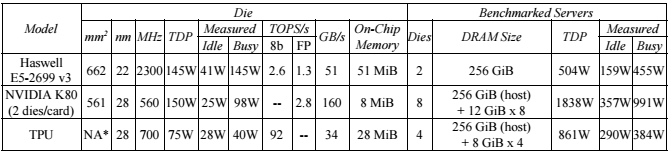
※ 이 논문은 TPU2 가 아닌 TPU(1세대) 을 대상으로 작성된 논문입니다.
-
세상의모든계산기
NVIDIA V100
출처 : https://devblogs.nvidia.com/parallelforall/inside-volta/?ncid=so-fac-vt-13920
Tesla V100 delivers industry-leading floating-point and integer performance. Peak computation rates (based on GPU Boost clock rate) are:
7.5 TFLOP/s of double precision floating-point (FP64) performance;
15 TFLOP/s of single precision (FP32) performance;
120 Tensor TFLOP/s of mixed-precision matrix-multiply-and-accumulate.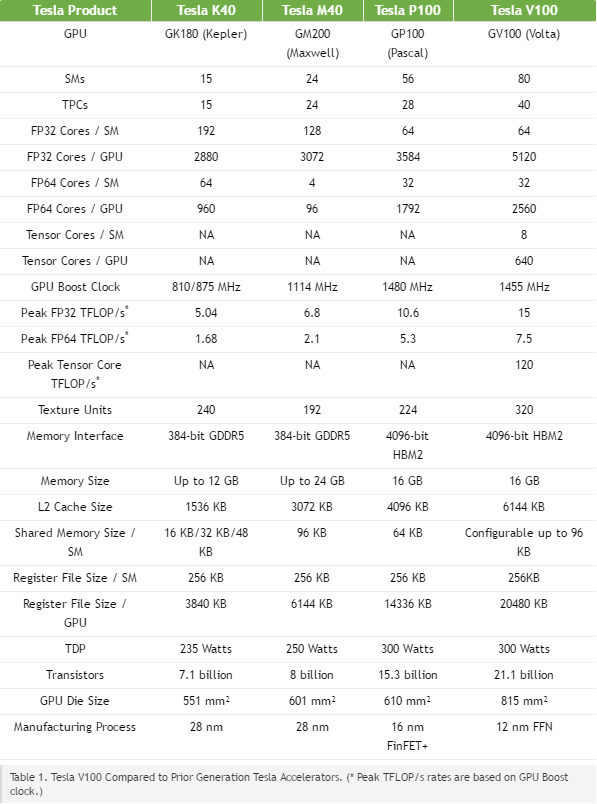
-
세상의모든계산기
팩트 정리를 해 보면...
1. 돌파고의 TPU는 TPU1 으로 불림2. 커파고의 TPU는 TPU2 로 불림
(칩을 TPU2 Chip 으로 부르기도 하는 듯)3. TPU2 모듈 1개는 TPU2코어 4개로 구성
4. TPU2 모듈의 성능 = 45테라플롭스/개*4개 = 180테라플롭스 (
5. https://www.tensorflow.org/tfrc/ 구글 텐서 크라우드?는 100개의 TPU2 모듈로 구성
각각의 TPU2 칩은 두개의 BlueLink 25GB/s 케이블로 연결 -
세상의모든계산기
추정
CPU 종류와 그 비율
출처 : https://www.nextplatform.com/2017/05/22/hood-googles-tpu2-machine-learning-clusters/
We believe that Google connected each CPU board to exactly one TPU2 board using both OPA cables to achieve 25 GB/s aggregate bandwidth. This one-to-one connectivity answers a key question for TPU2 – Google designed the TPU2 stamp with a 2:1 ratio of TPU2 chips to Xeon sockets. That is, four TPU2 chips for every dual-socket Xeon server.> 클라우드가 아닌 싱글머쉰에서 알파고가 돌아갔다면 제온 2소켓 보드 + TPU2 모듈*1개 구성이 맞는 듯
> CPU는 구글 문서에 나온대로 INTEL XEON E5-2699v3 인것 같음. 실질적 계산 역할은 그리 크지 않은 듯.
(seldom 하게 2.3GHz 이외 클럭으로 동작)> 전력소모는 구글 문서에 나온대로 TDP 861W, IDLE 290W, BUSY 384W (싱글머쉰 기준) 이 맞는 듯

세상의모든계산기 님의 최근 댓글
- claude AI는 l-c*r^2 을 1-c*r^2 으로 잘못 읽고 표시하고 있습니다. - TI-nspire CAS 계산기에 l-c*r^2 ≥0 을 조건에 추가해 계산해 보아도 결과는 바뀌지 않습니다. 2026 07.20 ⚠️ 경고가 바로 두 번째 방법이 "성공"한 이유와 정확히 연결되어 있습니다. 경고의 의미 "Domain of the result might be larger than the domain of the input"는 CAS가 절댓값(모듈러스)을 계산하는 과정에서 원래 식보다 정의역이 더 넓은 형태로 단순화했다는 뜻입니다. 구체적으로 이 계산은 내부적으로 대략 이런 과정을 거칩니다. $$\left|\frac{er}{e\cdot r}\right| = \sqrt{\left(\frac{er}{e\cdot r}\right)\cdot\overline{\left(\frac{er}{e\cdot r}\right)}}$$ 즉 원래 식(복소수)과 그 켤레복소수를 곱해서 실수부·허수부 제곱합을 만들고, 거기에 다시 제곱근을 씌우는 과정입니다. 이 과정에서 √(x²) → x 또는 √a·√b → √(ab) 같은 규칙들이 쓰이는데, 이런 규칙들은 x가 실수이고 0 이상일 때만 엄밀하게 성립합니다. CAS는 이 조건들을 일일이 다 추적하지 않고 넘어가면서, 원래는 (e≠0, r+l·ω·i ≠ 0 등) 복소수 특유의 좁은 정의역을 가진 식을, r, l, ω가 어떤 실수여도(부호 무관하게) 정의되는 1/√(r²+l²·ω²)라는 더 넓은 정의역의 식으로 바꿔버린 것입니다. CAS는 이 손실을 감지하고 경고를 띄운 것입니다. 이게 왜 조건 대입 성공과 연결되는가 정리하면, 이 경고는 사실상 이런 뜻입니다. "나는 이 결과를 만들면서 원래 식이 가지고 있던 정의역 제약 정보(부호 조건, i 관련 조건 등)를 이미 버렸다." 바로 이 "정의역 정보를 버린" 상태가 이후 con_1 대입을 매끄럽게 만드는 원인입니다. 첫 번째 시도에서는 i가 살아있는 원래 식에 조건을 대입했기 때문에, CAS가 √(1-c·r²)이 실수인지(정의역 조건: 1-c·r² ≥ 0) 계속 추적하려고 했고, 그 정보가 con에 없어서 더 이상 정리를 못 하고 멈췄습니다. 두 번째 시도에서는 절댓값 계산 단계에서 이미 그런 세밀한 정의역 추적을 CAS 스스로 포기(단순화)했기 때문에, 이후 ω에 무리식을 대입해도 "이게 실수가 맞나?" 하는 검증 절차 없이 그냥 대수적으로 치환·정리해 버립니다. 그래서 깔끔하게 √c/√l이 나온 겁니다. 한 줄 요약 절댓값 계산 시 뜬 "정의역이 넓어졌을 수 있다"는 경고는, CAS가 그 순간에 원래 식의 엄밀한 조건(정의역)을 놓쳤다는 신호이고, 바로 그 "조건을 놓친 상태"이기 때문에 뒤에 이어지는 조건식 대입이 막힘없이 진행된 것입니다. 다만 그 대가로, 결과인 1/√(r²+l²·ω²)이나 최종 √c/√l이 원래 회로 조건(i≠0이 되는 경계, 분모가 0이 되는 경우 등)에서는 엄밀히 성립하지 않을 수 있다는 점은 감안하셔야 합니다. 실제 물리적으로는 r, l, c > 0이고 결과도 물리적으로 타당한 형태라 문제없어 보이지만, 수학적 엄밀성 측면에서는 "정의역이 넓어진 근사적 결과"라는 꼬리표가 붙어있는 셈입니다. 2026 07.20 Claude AI 답변 TI-Nspire CAS의 | (such that / 조건대입) 연산자는 대입 시점의 수식 형태를 그대로 두고 기호만 치환하는 연산입니다. 대입 후에 처음부터 다시 "실수부/허수부 분리, 유리화" 같은 재간소화를 자동으로 수행하지 않습니다. 이 차이가 지금 보신 결과 차이의 핵심입니다. 첫 번째 경우 (|er/(e·r)| | con_1 and con → 실패) 이 시점의 식은 아직 r + l·ω·i 형태의 복소수 그대로입니다 (i가 살아있음). 여기에 con_1: ω = √(1-c·r²)/(√c·l)을 대입하면, 분모 안에 i · √(1-c·r²) 라는 항이 새로 생깁니다. 문제는 CAS가 √(1-c·r²)이 실수인지(즉 1-c·r² ≥ 0인지) 판단할 근거가 없다는 겁니다. 저장해 두신 con 조건은 c>0, l>0, r>0뿐이고, 1-c·r²≥0이라는 조건은 포함되어 있지 않습니다. 그래서 CAS는 i와 이 무리식을 더 정리(유리화, 실수부·허수부 재결합)하지 못하고 있는 그대로 남겨둡니다. 결과에 여전히 i가 보이는 이유입니다. 두 번째 경우 (결과값 1/√(r²+l²·ω²)에 대입 → 성공) |er/(e·r)| (절댓값/모듈러스) 연산은 그 자체로 이미 "복소수 → 실수" 변환을 완료한 결과입니다. 즉 1/√(r²+l²·ω²)에는 더 이상 i가 없고, 순수하게 r, l, ω로만 이루어진 실수식입니다. 이 식에 ω = con_1을 대입하는 것은 그냥 실수 대수식에 실수 대입하는 것이므로, i와 무리식이 뒤엉키는 문제 자체가 발생하지 않습니다. 그래서 바로 깔끔하게 √c/√l로 정리됩니다. 정리하면 절댓값(모듈러스) 계산은 "이 값들이 실수다"라는 가정을 이미 내부적으로 써서 i를 제거하는 연산입니다. 그 연산을 조건 대입 이전에 해두면, 이후 대입은 단순 실수 대입이라 문제없이 정리됩니다. 반대로 i가 남아있는 식에 무리식을 포함한 조건을 먼저 대입하면, 그 무리식의 실수성/부호에 대한 가정이 없어서 CAS가 i를 소거하는 재간소화를 못 하고 멈춰버립니다. 실용적 팁: 복소식에 조건을 대입해야 할 때는 가능하면 절댓값·실수화(유리화) 등을 먼저 끝내서 i를 없앤 뒤 조건을 대입하거나, 대입 후 결과에 다시 simplify/expand/combine 같은 명령을 한 번 더 걸어주면 (필요한 도메인 조건과 함께) 정리가 되는 경우가 많습니다. 2026 07.19 저도 어림잡아 추측할 뿐이지 정확한 이유를 알지는 못합니다. 질문하신 사진을 그대로 (Gemini 3.5 Flash / ChatGPT / Claude Sonnet 5) AI에 넣어 보니 claude AI 가 제일 합리적인 답변을 주어서 이를 붙여 넣습니다. 2026 07.19 아 그렇네요. 감사합니다. ^^ 2026 04.28