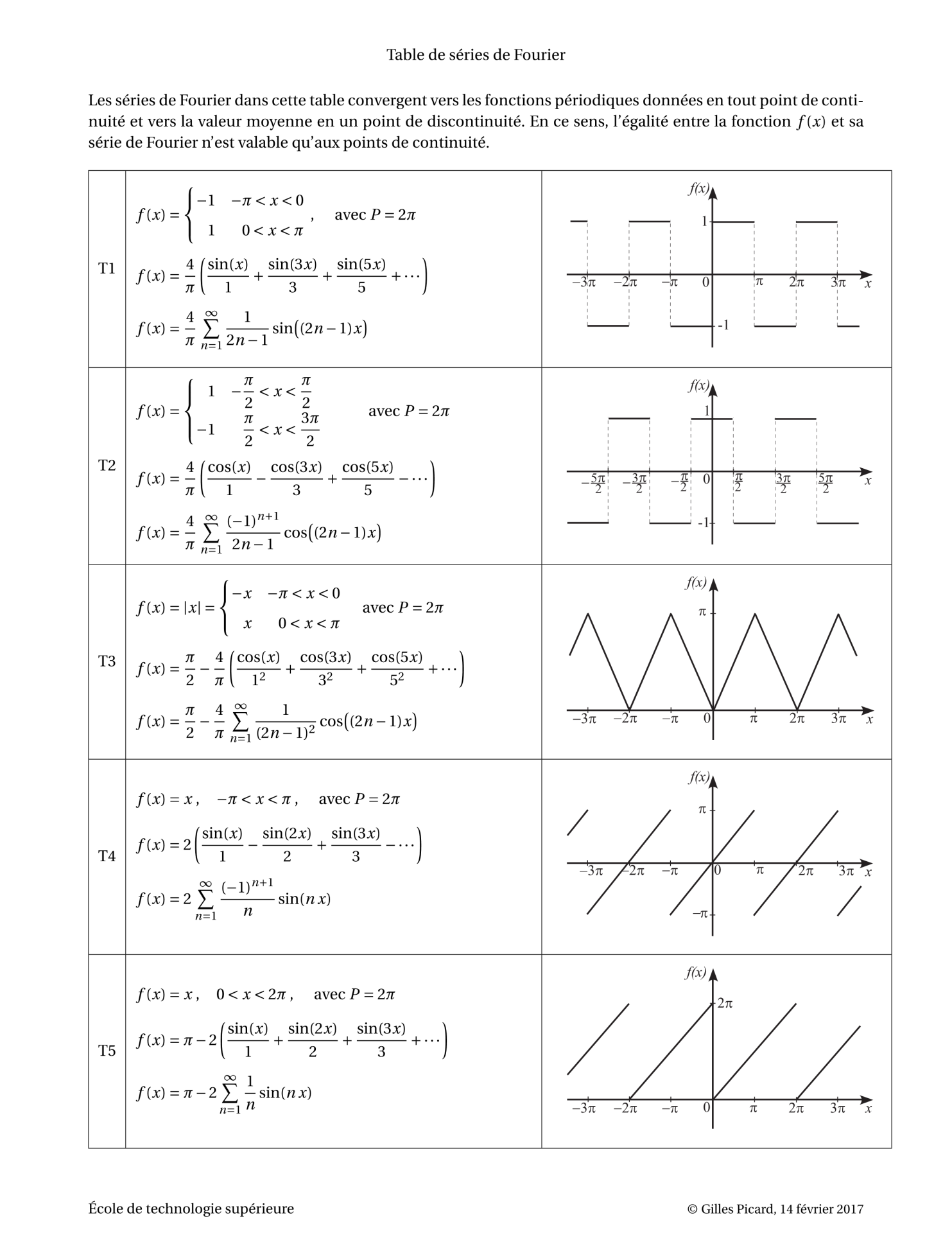
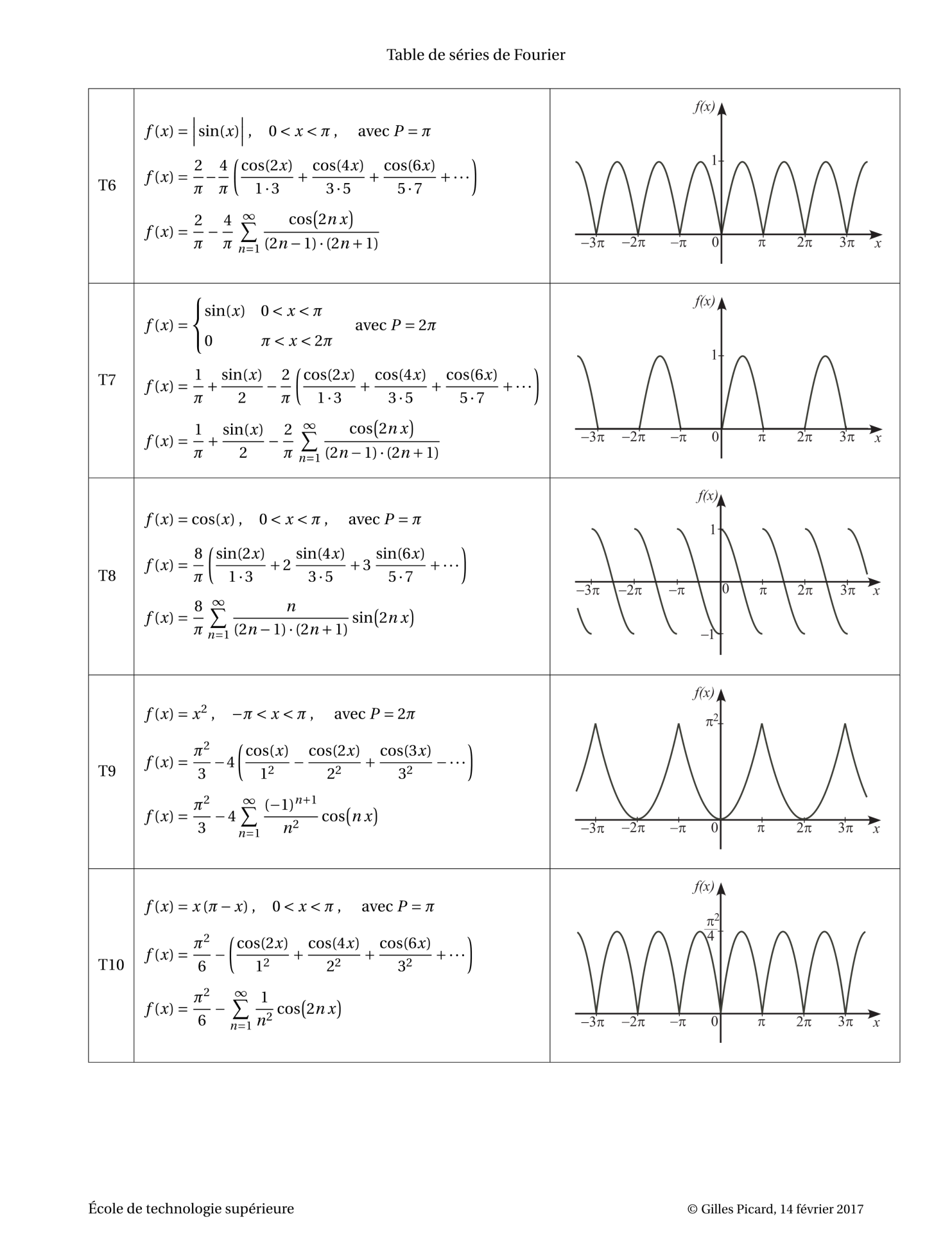
푸리에 급수 테이블 , 푸리에 변환 테이블, Fourier Series Table, Fourier Transform Table
-

- 2024.11.15 - 00:05 2024.11.14 - 11:27 706
출처 : https://ena.etsmtl.ca/pluginfile.php/137982/mod_resource/content/8/Fourier-table.pdf
출처 : https://en.wikipedia.org/wiki/Fourier_transform
Functional relationships, one-dimensional
The Fourier transforms in this table may be found in [Erdélyi 1954] or [Kammler 2000, appendix].
| Function | Fourier transform unitary, ordinary frequency |
Fourier transform unitary, angular frequency |
Fourier transform non-unitary, angular frequency |
Remarks | |
|---|---|---|---|---|---|
| \[f(x)\] | \[\begin{align} &\widehat{f}(\xi) \triangleq \widehat {f_1}(\xi) \\&= \int_{-\infty}^\infty f(x) e^{-i 2\pi \xi x}\, dx \end{align}\] | \[\begin{align} &\widehat{f}(\omega) \triangleq \widehat {f_2}(\omega) \\&= \frac{1}{\sqrt{2 \pi}} \int_{-\infty}^\infty f(x) e^{-i \omega x}\, dx \end{align}\] | \[\begin{align} &\widehat{f}(\omega) \triangleq \widehat {f_3}(\omega) \\&= \int_{-\infty}^\infty f(x) e^{-i \omega x}\, dx \end{align}\] | Definitions | |
| 101 | \[a\, f(x) + b\, g(x)\] | \[a\, \widehat{f}(\xi) + b\, \widehat{g}(\xi)\] | \[a\, \widehat{f}(\omega) + b\, \widehat{g}(\omega)\] | \[a\, \widehat{f}(\omega) + b\, \widehat{g}(\omega)\] | Linearity |
| 102 | \[f(x - a)\] | \[e^{-i 2\pi \xi a} \widehat{f}(\xi)\] | \[e^{- i a \omega} \widehat{f}(\omega)\] | \[e^{- i a \omega} \widehat{f}(\omega)\] | Shift in time domain |
| 103 | \[f(x)e^{iax}\] | \[\widehat{f} \left(\xi - \frac{a}{2\pi}\right)\] | \[\widehat{f}(\omega - a)\] | \[\widehat{f}(\omega - a)\] | Shift in frequency domain, dual of 102 |
| 104 | \[f(a x)\] | \[\frac{1}{|a|} \widehat{f}\left( \frac{\xi}{a} \right)\] | \[\frac{1}{|a|} \widehat{f}\left( \frac{\omega}{a} \right)\] | \[\frac{1}{|a|} \widehat{f}\left( \frac{\omega}{a} \right)\] | Scaling in the time domain. If \[{{abs|a}}\] is large, then \[f(ax)\] is concentrated around 0 and \[\frac{1}{|a|}\hat{f} \left( \frac{\omega}{a} \right)\] spreads out and flattens. |
| 105 | \[\widehat {f_n}(x)\] | \[\widehat {f_1}(x) \ \stackrel{\mathcal{F}_1}{\longleftrightarrow}\ f(-\xi)\] | \[\widehat {f_2}(x) \ \stackrel{\mathcal{F}_2}{\longleftrightarrow}\ f(-\omega)\] | \[\widehat {f_3}(x) \ \stackrel{\mathcal{F}_3}{\longleftrightarrow}\ 2\pi f(-\omega)\] | The same transform is applied twice, but x replaces the frequency variable (ξ or ω) after the first transform. |
| 106 | \[\frac{d^n f(x)}{dx^n}\] | \[(i 2\pi \xi)^n \widehat{f}(\xi)\] | \[(i\omega)^n \widehat{f}(\omega)\] | \[(i\omega)^n \widehat{f}(\omega)\] | nth-order derivative. As \[f\] is a [[Schwartz space|Schwartz function]] |
| 106.5 | \[\int_{-\infty}^{x} f(\tau) d \tau\] | \[\frac{\widehat{f}(\xi)}{i 2 \pi \xi} + C \, \delta(\xi)\] | \[\frac{\widehat{f} (\omega)}{i\omega} + \sqrt{2 \pi} C \delta(\omega)\] | \[\frac{\widehat{f} (\omega)}{i\omega} + 2 \pi C \delta(\omega)\] | Integration.[1] Note: \[\delta\] is the [[Dirac delta function]] and \[C\] is the average ([[DC component|DC]]) value of \[f(x)\] such that \[\int_{-\infty}^\infty (f(x) - C) \, dx = 0\] |
| 107 | \[x^n f(x)\] | \[\left (\frac{i}{2\pi}\right)^n \frac{d^n \widehat{f}(\xi)}{d\xi^n}\] | \[i^n \frac{d^n \widehat{f}(\omega)}{d\omega^n}\] | \[i^n \frac{d^n \widehat{f}(\omega)}{d\omega^n}\] | This is the dual of 106 |
| 108 | \[(f * g)(x)\] | \[\widehat{f}(\xi) \widehat{g}(\xi)\] | \[\sqrt{2\pi}\ \widehat{f}(\omega) \widehat{g}(\omega)\] | \[\widehat{f}(\omega) \widehat{g}(\omega)\] | The notation \[f * g\] denotes the [[convolution]] of \[f\] and \[g\] — this rule is the [[convolution theorem]] |
| 109 | \[f(x) g(x)\] | \[\left(\widehat{f} * \widehat{g}\right)(\xi)\] | \[ \frac{1}{\sqrt{2\pi}} \left(\widehat{f} * \widehat{g}\right)(\omega) \] | \[\frac{1}{2\pi}\left(\widehat{f} * \widehat{g}\right)(\omega)\] | This is the dual of 108 |
| 110 | For \[f(x)\] purely real | \[\widehat{f}(-\xi) = \overline{\widehat{f}(\xi)}\] | \[\widehat{f}(-\omega) = \overline{\widehat{f}(\omega)}\] | \[\widehat{f}(-\omega) = \overline{\widehat{f}(\omega)}\] | Hermitian symmetry. \[\overline{z}\] indicates the [[complex conjugate]]. |
| 113 | For \[f(x)\] purely imaginary | \[\widehat{f}(-\xi) = -\overline{\widehat{f}(\xi)}\] | \[\widehat{f}(-\omega) = -\overline{\widehat{f}(\omega)}\] | \[\widehat{f}(-\omega) = -\overline{\widehat{f}(\omega)}\] | \[\overline{z}\] indicates the [[complex conjugate]]. |
| 114 | \[\overline{f(x)}\] | \[\overline{\widehat{f}(-\xi)}\] | \[\overline{\widehat{f}(-\omega)}\] | \[\overline{\widehat{f}(-\omega)}\] | [[Complex conjugation]], generalization of 110 and 113 |
| 115 | \[f(x) \cos (a x)\] | \[\frac{\widehat{f}\left(\xi - \frac{a}{2\pi}\right)+\widehat{f}\left(\xi+\frac{a}{2\pi}\right)}{2}\] | \[\frac{\widehat{f}(\omega-a)+\widehat{f}(\omega+a)}{2}\] | \[\frac{\widehat{f}(\omega-a)+\widehat{f}(\omega+a)}{2}\] | This follows from rules 101 and 103 using [[Euler's formula]]: \[\cos(a x) = \frac{e^{i a x} + e^{-i a x}}{2}.\] |
| 116 | \[f(x)\sin( ax)\] | \[\frac{\widehat{f}\left(\xi-\frac{a}{2\pi}\right)-\widehat{f}\left(\xi+\frac{a}{2\pi}\right)}{2i}\] | \[\frac{\widehat{f}(\omega-a)-\widehat{f}(\omega+a)}{2i}\] | \[\frac{\widehat{f}(\omega-a)-\widehat{f}(\omega+a)}{2i}\] | This follows from 101 and 103 using [[Euler's formula]]: \[\sin(a x) = \frac{e^{i a x} - e^{-i a x}}{2i}.\] |
[1] The Integration Property of the Fourier Transform
| Function | Fourier transform unitary, ordinary frequency |
Fourier transform unitary, angular frequency |
Fourier transform non-unitary, angular frequency |
Remarks | |
|---|---|---|---|---|---|
| \[ f(x) \] | \[ \begin{align} &\hat{f}(\xi) \triangleq \hat f_1(\xi) \\&= \int_{-\infty}^\infty f(x) e^{-i 2\pi \xi x}\, dx \end{align} \] | \[ \begin{align} &\hat{f}(\omega) \triangleq \hat f_2(\omega) \\&= \frac{1}{\sqrt{2 \pi}} \int_{-\infty}^\infty f(x) e^{-i \omega x}\, dx \end{align} \] | \[ \begin{align} &\hat{f}(\omega) \triangleq \hat f_3(\omega) \\&= \int_{-\infty}^\infty f(x) e^{-i \omega x}\, dx \end{align} \] | Definitions | |
| 301 | \[ 1 \] | \[ \delta(\xi) \] | \[ \sqrt{2\pi}\, \delta(\omega) \] | \[ 2\pi\delta(\omega) \] | The distribution \[ ''δ''(''ξ'') \] denotes the [[Dirac delta function]]. |
| 302 | \[ \delta(x) \] | \[ 1 \] | \[ \frac{1}{\sqrt{2\pi}} \] | \[ 1 \] | Dual of rule 301. |
| 303 | \[ e^{i a x} \] | \[ \delta\left(\xi - \frac{a}{2\pi}\right) \] | \[ \sqrt{2 \pi}\, \delta(\omega - a) \] | \[ 2 \pi\delta(\omega - a) \] | This follows from 103 and 301. |
| 304 | \[ \cos (a x) \] | \[ \frac{\delta\left(\xi - \frac{a}{2\pi}\right)+\delta\left(\xi+\frac{a}{2\pi}\right)}{2} \] | \[ \sqrt{2 \pi}\,\frac{\delta(\omega-a)+\delta(\omega+a)}{2} \] | \[ \pi\left(\delta(\omega-a)+\delta(\omega+a)\right) \] | This follows from rules 101 and 303 using [[Euler's formula]]: \[ \cos(a x) = \frac{e^{i a x} + e^{-i a x}}{2}. \] |
| 305 | \[ \sin( ax) \] | \[ \frac{\delta\left(\xi-\frac{a}{2\pi}\right)-\delta\left(\xi+\frac{a}{2\pi}\right)}{2i} \] | \[ \sqrt{2 \pi}\,\frac{\delta(\omega-a)-\delta(\omega+a)}{2i} \] | \[ -i\pi\bigl(\delta(\omega-a)-\delta(\omega+a)\bigr) \] | This follows from 101 and 303 using \[ \sin(a x) = \frac{e^{i a x} - e^{-i a x}}{2i}. \] |
| 306 | \[ \cos \left( a x^2 \right) \] | \[ \sqrt{\frac{\pi}{a}} \cos \left( \frac{\pi^2 \xi^2}{a} - \frac{\pi}{4} \right) \] | \[ \frac{1}{\sqrt{2 a}} \cos \left( \frac{\omega^2}{4 a} - \frac{\pi}{4} \right) \] | \[ \sqrt{\frac{\pi}{a}} \cos \left( \frac{\omega^2}{4a} - \frac{\pi}{4} \right) \] | This follows from 101 and 207 using \[ \cos(a x^2) = \frac{e^{i a x^2} + e^{-i a x^2}}{2}. \] |
| 307 | \[ \sin \left( a x^2 \right) \] | \[ - \sqrt{\frac{\pi}{a}} \sin \left( \frac{\pi^2 \xi^2}{a} - \frac{\pi}{4} \right) \] | \[ \frac{-1}{\sqrt{2 a}} \sin \left( \frac{\omega^2}{4 a} - \frac{\pi}{4} \right) \] | \[ -\sqrt{\frac{\pi}{a}}\sin \left( \frac{\omega^2}{4a} - \frac{\pi}{4} \right) \] | This follows from 101 and 207 using \[ \sin(a x^2) = \frac{e^{i a x^2} - e^{-i a x^2}}{2i}. \] |
| 308 | \[ e^{-\pi i\alpha x^2} \] | \[ \frac{1}{\sqrt{\alpha}}\, e^{-i\frac{\pi}{4}} e^{i\frac{\pi \xi^2}{\alpha}} \] | \[ \frac{1}{\sqrt{2\pi \alpha}}\, e^{-i\frac{\pi}{4}} e^{i\frac{\omega^2}{4\pi \alpha}} \] | \[ \frac{1}{\sqrt{\alpha}}\, e^{-i\frac{\pi}{4}} e^{i\frac{\omega^2}{4\pi \alpha}} \] | Here it is assumed \[ \alpha \] is real. For the case that alpha is complex see table entry 206 above. |
| 309 | \[ x^n \] | \[ \left(\frac{i}{2\pi}\right)^n \delta^{(n)} (\xi) \] | \[ i^n \sqrt{2\pi} \delta^{(n)} (\omega) \] | \[ 2\pi i^n\delta^{(n)} (\omega) \] | Here, \[ n \] is a [[natural number]] and \[ ''δ''{{isup|(''n'')}}\left(\xi\right) \] is the \[ n \]th distribution derivative of the Dirac delta function. This rule follows from rules 107 and 301. Combining this rule with 101, we can transform all [[polynomial]]s. |
| 310 | \[ \delta^{(n)}(x) \] | \[ (i 2\pi \xi)^n \] | \[ \frac{(i\omega)^n}{\sqrt{2\pi}} \] | \[ (i\omega)^n \] | Dual of rule 309. \[ ''δ''{{isup|(''n'')}}\left(\xi\right) \] is the \[ n \]th distribution derivative of the Dirac delta function. This rule follows from 106 and 302. |
| 311 | \[ \frac{1}{x} \] | \[ -i\pi\sgn(\xi) \] | \[ -i\sqrt{\frac{\pi}{2}}\sgn(\omega) \] | \[ -i\pi\sgn(\omega) \] | Here \[ sgn(\xi) \] is the [[sign function]]. Note that \[ \frac{1}{x} \] is not a distribution. It is necessary to use the [[Cauchy principal value]] when testing against [[Schwartz functions]]. This rule is useful in studying the [[Hilbert transform]]. |
| 312 | \[ \begin{align} &\frac{1}{x^n} \\ &:= \frac{(-1)^{n-1}}{(n-1)!}\frac{d^n}{dx^n}\log |x| \end{align} \] | \[ -i\pi \frac{(-i 2\pi \xi)^{n-1}}{(n-1)!} \sgn(\xi) \] | \[ -i\sqrt{\frac{\pi}{2}}\, \frac{(-i\omega)^{n-1}}{(n-1)!}\sgn(\omega) \] | \[ -i\pi \frac{(-i\omega)^{n-1}}{(n-1)!}\sgn(\omega) \] | \[ \frac{1}{x^n} \] is the [[homogeneous distribution]] defined by the distributional derivative \[ \frac{(-1)^{n-1}}{(n-1)!}\frac{d^n}{dx^n}\log|x| \] |
| 313 | \[ |x|^\alpha \] | \[ -\frac{2\sin\left(\frac{\pi\alpha}{2}\right)\Gamma(\alpha+1)}{|2\pi\xi|^{\alpha+1}} \] | \[ \frac{-2}{\sqrt{2\pi}}\, \frac{\sin\left(\frac{\pi\alpha}{2}\right)\Gamma(\alpha+1)}{|\omega|^{\alpha+1}} \] | \[ -\frac{2\sin\left(\frac{\pi\alpha}{2}\right)\Gamma(\alpha+1)}{|\omega|^{\alpha+1}} \] | This formula is valid for \[ 0 > \alpha > -1 \]. For \[ \alpha > 0 \] some singular terms arise at the origin that can be found by differentiating 320. If \[ Re \alpha > -1 \], then \[ |x|^\alpha \] is a locally integrable function, and so a tempered distribution. The function \[ \alpha \mapsto |x|^\alpha \] is a holomorphic function from the right half-plane to the space of tempered distributions. It admits a unique meromorphic extension to a tempered distribution, also denoted \[ |x|^\alpha \] for \[ \alpha \neq -1, -3, ... \] (See [[homogeneous distribution]].) |
| \[ \frac{1}{\sqrt{|x|}} \] | \[ \frac{1}{\sqrt{|\xi|}} \] | \[ \frac{1}{\sqrt{|\omega|}} \] | \[ \frac{\sqrt{2\pi}}{\sqrt{|\omega|}} \] | Special case of 313. | |
| 314 | \[ \sgn(x) \] | \[ \frac{1}{i\pi \xi} \] | \[ \sqrt{\frac{2}{\pi}} \frac{1}{i\omega} \] | \[ \frac{2}{i\omega} \] | The dual of rule 311. This time the Fourier transforms need to be considered as a [[Cauchy principal value]]. |
| 315 | \[ u(x) \] | \[ \frac{1}{2}\left(\frac{1}{i \pi \xi} + \delta(\xi)\right) \] | \[ \sqrt{\frac{\pi}{2}} \left( \frac{1}{i \pi \omega} + \delta(\omega)\right) \] | \[ \pi\left( \frac{1}{i \pi \omega} + \delta(\omega)\right) \] | The function \[ u(x) \] is the Heaviside [[Heaviside step function|unit step function]]; this follows from rules 101, 301, and 314. |
| 316 | \[ \sum_{n=-\infty}^{\infty} \delta (x - n T) \] | \[ \frac{1}{T} \sum_{k=-\infty}^{\infty} \delta \left( \xi -\frac{k }{T}\right) \] | \[ \frac{\sqrt{2\pi }}{T}\sum_{k=-\infty}^{\infty} \delta \left( \omega -\frac{2\pi k}{T}\right) \] | \[ \frac{2\pi}{T}\sum_{k=-\infty}^{\infty} \delta \left( \omega -\frac{2\pi k}{T}\right) \] | This function is known as the [[Dirac comb]] function. This result can be derived from 302 and 102, together with the fact that \[ \begin{align} & \sum_{n=-\infty}^{\infty} e^{inx} \\ = {}& 2\pi\sum_{k=-\infty}^{\infty} \delta(x+2\pi k) \end{align} \] as distributions. |
| 317 | \[ J_0 (x) \] | \[ \frac{2\, \operatorname{rect}(\pi\xi)}{\sqrt{1 - 4 \pi^2 \xi^2}} \] | \[ \sqrt{\frac{2}{\pi}} \, \frac{\operatorname{rect}\left(\frac{\omega}{2}\right)}{\sqrt{1 - \omega^2}} \] | \[ \frac{2\,\operatorname{rect}\left(\frac{\omega}{2}\right)}{\sqrt{1 - \omega^2}} \] | The function \[ J_0(x) \] is the zeroth order [[Bessel function]] of first kind. |
-
25
세상의모든계산기 님의 최근 댓글
[fx-570 ES] 과학 상수를 이용한 계산에서 에러 발생 상황 https://kin.naver.com/qna/detail.naver?d1id=11&dirId=1118&docId=492235162&page=1&answerNo=1 vs 2026 03.01 과학상수를 이용한 계산 중 자릿수 한계로 인한 에러 발생 가능성 https://allcalc.org:443/board_calculators/6925#comment_57029 2026 03.01 기본 어댑터 MODEL : AD0301-1202500GB INPUT : 100~240V, 50~60Hz, 0.8A Max OUTPUT : 12.0V, 2.5A, 30.0W ㄴ 측정시 플러그 외경/내경 : 5.5mm / 2mm 2026 02.15 엑셀 파일로 만드니 전체 160~200MB 정도 나옵니다. 읽고 / 저장하는데 한참 걸리네요. 컴 사양을 좀 탈 것 같습니다. -> 엑셀/한셀에서 읽히지만, 구글 스프레드시트에서는 열리지 않네요. 100만 개 단위로 끊어서 20MB 정도로 분할해 저장하는 편이 오히려 속 편할 것 같습니다. -> 이건 구글 스프레드시트에서도 열리긴 하네요. (약간 버퍼링?이 있습니다) 2026 02.10 엑셀 / 행의 최대 개수, 열의 최대 개수, 셀의 최대 개수 엑셀의 행 개수 제한은 파일 형식에 따라 다르며, 최신 .xlsx 파일 형식은 시트당 최대 1,048,576행까지 지원하지만, 구형 .xls 파일은 65,536행으로 제한됩니다. 따라서 대용량 데이터를 다룰 때는 반드시 최신 파일 형식(.)으로 저장해야 하며, 행과 열의 총 수는 1,048,576행 x 16,384열이 최대입니다. 주요 행 개수 제한 사항: 최신 파일 형식 (.xlsx, .xlsm, .xlsb 등): 시트당 1,048,576행 (2^20). 구형 파일 형식 (.xls): 시트당 65,536행 (2^16). 그 외 알아두면 좋은 점: 최대 행 수: 1,048,576행 (100만여개) 최대 열 수: 16,384열 (XFD) 대용량 데이터 처리: 65,536행을 초과하는 데이터를 다루려면 반드시 .xlsx 형식으로 저장하고 사용해야 합니다. 문제 해결: 데이터가 많아 엑셀이 멈추거나 오류가 발생하면, 불필요한 빈 행을 정리하거나 Inquire 추가 기능을 활용하여 파일을 최적화할 수 있습니다. 2026 02.10