
- 세상의 모든 계산기 수학, 과학, 공학 이야기 공학 ()
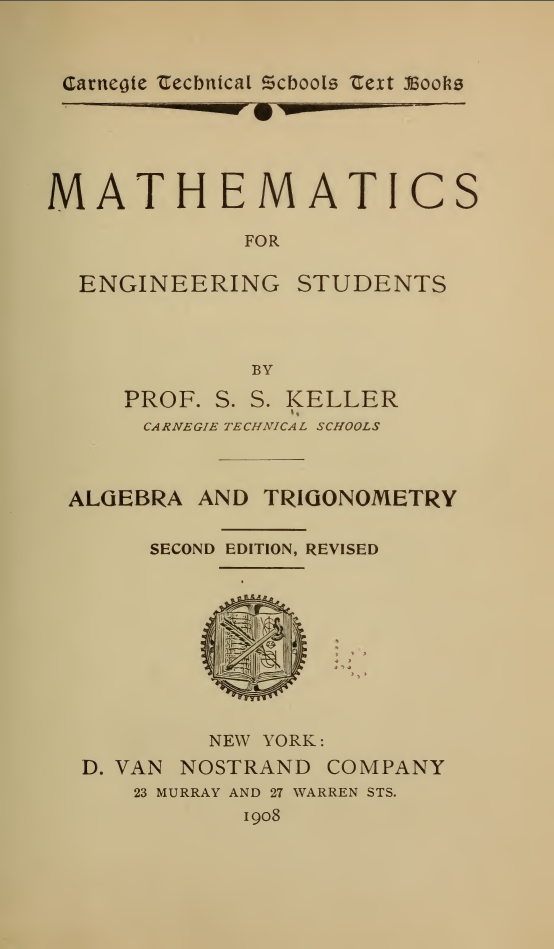
Mathematics For Engineering Students 1908
-

- 2024.08.06 - 21:28 2024.08.06 - 21:23 2364
1908년에 출판된 학생용 교재입니다.
기초적인 내용이 들어 있네요.
전부 보진 않았는데, 초중고에서 배우는 내용이 대부분인 듯 합니다.
https://www.survivorlibrary.com/index.php/Engineering_General
| 2016-11-15 | Mathematics For Engineering Students 1908 | PDF19 mb |
## Table of Contents
### Chapter I: Algebra and Arithmetic
1. **Definitions and Symbols**
Pages 1-3
2. **Addition**
- Addition of Monomials: Page 4
- Addition of Polynomials: Page 5
- Addition of Negative Numbers: Page 7
3. **Subtraction**
- Subtraction of Monomials: Page 5
- Subtraction of Polynomials: Page 6
- Subtraction of Negative Numbers: Page 7
4. **Multiplication and Division**
- Multiplication: Page 9
- Division: Page 10
5. **Exponents**
Page 10
6. **Polynomial Operations**
- Multiplication of a Polynomial by a Monomial: Page 11
- Division of a Polynomial by a Monomial: Page 11
- Multiplication of a Polynomial by a Polynomial: Page 12
- Division of a Polynomial by a Polynomial: Page 12
### Chapter II: Definitions and Types
1. **Definitions and Type Forms**
Pages 16-19
2. **Greatest Common Divisor**
Pages 20-24
3. **Least Common Multiple**
Pages 24-26
4. **Fractions**
Pages 27-29
### Chapter III: Equations
1. **General Concepts**
Pages 30-31
2. **Literal Equations and Uses of Letters**
Page 31
3. **Degree of an Equation**
Page 32
4. **Solving Equations**
- Clearing of Fractions: Page 33
- Transposition: Page 34
- Solution of Linear Equation of One Unknown: Page 34
- Simultaneous Linear Equations: Page 35
- Elimination by Substitution: Page 37
- Elimination by Indeterminate Coefficients: Page 38
- More than Two Unknowns: Page 39
### Chapter IV: Graphics
Pages 47-53
### Chapter V: The Binomial Theorem
- Involution and Evolution: Page 58
- Extraction of Roots: Page 59
- Square Root: Page 60
- Cube Root: Page 61
### Chapter VI: Surds
1. **Introduction to Surds**
Pages 65-66
2. **Simplification and Operations**
- Simplification: Page 67
- Order of a Surd: Page 68
- Reduction of Mixed Surds: Page 69
- Addition and Subtraction: Page 69
- Multiplication and Division: Pages 69-70
- Comparison: Page 70
- Rationalizing Denominators: Page 71
3. **Roots of Quadratic Surds**
- General Method: Page 74
- Another Method: Page 75
4. **Imaginaries**
Pages 77-77
- Multiplication of Imaginaries: Page 77
### Chapter VII: Indeterminate Equations
Pages 80-87
### Chapter VIII: Quadratic Equations
1. **Basics of Quadratics**
- Single Unknown: Page 88
- Kinds of Quadratics: Page 88
2. **Solving Quadratics**
- Roots of a Quadratic: Page 89
- Solution of Incomplete Quadratic: Page 89
- Solution of Complete Quadratic: Page 89
- Geometrical Illustration: Page 90
- Literal and Numerical Equations: Page 90
- Solution by Factoring: Page 91
- Solution by Substitution: Page 93
- Equations Involving Radicals: Page 93
- Equations of Higher Degree: Page 94
- Solution by Factoring: Page 95
- Character of Roots: Page 96
3. **Maxima and Minima**
Page 102
4. **Equations of Two or More Unknowns**
- Degree Higher than the First: Page 105
### Chapter IX: Logarithms
1. **Introduction to Logarithms**
Page 114
2. **Logarithms of Decimals**
Page 117
3. **Cologarithms**
Page 119
4. **Finding a Number from Its Logarithm**
Page 120
### Chapter X: Inequalities
Pages 125-127
### Chapter XI: Progressions
1. **Arithmetical Series**
Page 136
2. **Arithmetical Mean**
Page 138
3. **Geometrical Progression**
- Value of Any Term: Page 141
- Geometrical Mean: Page 142
4. **Infinite Series**
Page 143
5. **Harmonical Progression**
Page 145
### Chapter XII: Interest and Annuities
1. **Interest Definitions**
Page 147
2. **Simple Interest**
Page 147
3. **Compound Interest**
Page 147
4. **Annuities**
Page 148
### Plane Trigonometry
#### Part I: Basic Trigonometry
1. **Relation between Angle and Line**
Page 155
2. **Trigonometric Ratios**
Page 156
3. **Functions**
- Functions of 45°: Page 161
- Functions of 60°: Page 162
4. **Identities**
Page 168
5. **Trigonometric Equations**
Page 169
#### Part II: Solution of Triangles
1. **The Right Triangle**
Page 172
2. **The Isosceles Triangle**
Page 174
3. **Regular Polygons**
Page 175
4. **Areas**
Page 177
#### Part III: Further Relations
1. **Functions of Angles**
- Expressing Functions in Terms of First Quadrant Angles: Page 193
- Sum and Difference of Functions: Page 200
- Functions of Half an Angle: Page 209
2. **Inverse Trigonometric Functions**
Page 213
#### Part IV: Solution of Oblique Triangles
Page 215
#### Part V: Spherical Trigonometry
1. **Right Spherical Triangles**
Page 225
2. **The Isosceles Triangle**
Page 230
3. **The Oblique Triangle**
Page 231
#### Part VI: Applications
1. **Area of a Spherical Triangle**
Page 244
-
25
세상의모든계산기 님의 최근 댓글
본문의 변환 위젯에 사용된 전서체 폰트는 대만의 최고 학술 연구 기관인 중앙연구원(Academia Sinica)에서 제공하는 ‘숭희전체(崇羲篆體)’로 전통 한자 서체인 소전(小篆)을 현대 컴퓨터 폰트(글꼴)로 구축한 오픈소스 프로젝트로 개발되었습니다. https://xiaoxue.iis.sinica.edu.tw/chongxi/download.htm 2026 10.20 예제1) 예제2) 예제3) 추가옵션 2026 10.18 PC 소프트웨어에서 script Editor 로 소스코드를 쉽게 복사 -> AI에게 문의/개선요청 할 수 있습니다. 잘 되거나, 잘 안되는 부분이 있으면 대댓글 남겨주세요. 2026 10.16 AI로 딸깍하니까, lua 프로그램으로 바꿔주네요. 세상 참... 본문의 ti-basic 기반으로 만들었고, 서로 문제를 일으킬 수 있을 듯 하여 별개의 파일로 작성하였습니다. 1.1 Page : 설명 1.2 Page : 그래프 1.3 Page : Calculator 사용법 Root Locus 1+K*N/D=0 EX: (6s^2+5s+2)/(6s^3(s^2+7s+16)) INPUT (Calculator page 1.3 ): rl_num:={6,5,2} rl_den:={6,42,96,0,0,0} or num(6s^2+5s+2) den(6s^3(s^2+7s+16)) optional: rl_T:=10 rl_D:=1 Coeffs are descending powers of s. Back on graph page it refreshes itself, else press [r] or [enter]. KEYS: [+] [-] Kmax zoom, [0] reset, [r] reload MARKS: x=pole, o=zero, red line=real axis, gray dash=asymptote, box=break pt, diamond=j-cross VARS: rl_Kmax rl_sigma rl_r rl_JK rl_Jw 첨부파일 rlocus_lua.tns 2026 10.16 링크가 깨졌다고 하시니 404 에러가 나는 아래 링크를 말씀하시는 것 같은데 https://digilander.libero.it/fpirozzi/fourier.zip 이것은 TI-89 / TI-92 용 파일이며 [TI-92][TI-89] Fourier Transform Library https://allcalc.org/52455 링크의 Attached files + 안에 있습니다. 2026 09.11